
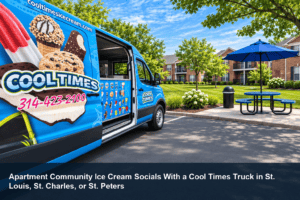
An ice cream truck can turn a courtyard, clubhouse area, or poolside gathering into an easy resident event. For apartment communities in St. Louis, St. Charles, and St. Peters, the best plan is simple: choose a safe truck location, confirm attendance, decide how residents will receive treats, and communicate the time clearly. Cool Times Ice Cream offers branded truck and cart service with wrapped ice cream novelties. Its truck and logo are part of the familiar experience, while the individual treats make distribution straightforward. The details should be confirmed with the company for each property and date.
Choose the purpose of the event
A resident social can welcome new neighbors, thank long-time residents, mark the beginning of summer, or provide a short after-school gathering. The purpose affects timing and location. A weekday evening may catch people returning from work; a weekend afternoon may suit families but compete with travel plans. Decide whether the event is open to all residents, limited to a building, or part of a larger program. That choice determines the likely head count and the communication plan. An ice cream truck works best when people know exactly when it will be present and can reach it without disrupting traffic or other amenities.
Confirm the service format with Cool Times
Cool Times uses trucks and carts for events. Ask which option fits the property, expected attendance, and available space. A truck offers a visible focal point and its own branded service window. A cart may fit a smaller or more restricted setting if the company offers it for that date. The company’s offerings should be confirmed directly. The planned treats are individually wrapped novelties, such as popsicles and drumstick-style items, subject to the current selection. Ask how the current menu is displayed at the service window so residents can choose quickly. Request the current menu and event terms before sending a resident flyer.
Find a safe truck position
Walk the property with a map. The truck needs a lawful place to park, a safe approach for residents, and enough clearance for emergency vehicles, deliveries, and ordinary traffic. Avoid blocking accessible parking, sidewalks, fire lanes, or building entrances. Consider where the service window will face, how a line will form, and whether children can wait away from moving cars. If the property has a gate, tell Cool Times how the driver will enter and where to check in. A good location is visible and convenient but does not turn a driveway into the event space. Confirm the final position with property management and the vendor.
Plan for accessibility and comfort
Residents may use mobility aids, strollers, or have difficulty standing in sun or rain. Choose a firm, level path to the truck or cart, and consider nearby shade and seating that do not obstruct the line. If the event is poolside, make sure the route does not require people to cross wet or restricted surfaces. Clear signs help residents find the correct gathering point. An evening event may need lighting. Ask whether the service window height or queue arrangement poses an accessibility issue and whether a cart would work better for a particular location. A welcoming event is one that residents can reach and enjoy without special negotiation.
Estimate attendance without overpromising
An apartment community may have hundreds of residents but a much smaller turnout during a short service window. Use prior event attendance, building occupancy, time of day, and RSVP responses to estimate demand. Tell Cool Times the range rather than presenting a guess as certainty. Ask how pricing and service time work if more or fewer residents arrive than expected. If the property pays for one treat per person, decide how that will be tracked. If residents buy their own, communicate payment arrangements clearly after confirming them with the company. A sensible estimate helps the vendor plan selection and helps management set a realistic budget.
Choose a payment model residents understand
The property might sponsor all treats, provide vouchers for a set number, or invite residents to purchase from the truck, depending on the vendor’s available arrangements. Decide who pays, what is included, and how extras will be handled before advertising. A “free ice cream” flyer can disappoint residents if only a limited quantity is covered. If vouchers are used, make them easy to redeem without collecting unnecessary personal information. Ask Cool Times how it handles billing, deposits, accepted payment methods, and changes to the count. Clear terms prevent a pleasant social from becoming an awkward line-management problem.
Communicate the right product expectations
The event notice should show the Cool Times truck or logo, the date, the service window, the location on the property, and a concise description such as “wrapped ice cream novelties.” Mention that selection is subject to availability. Do not promise a specific flavor or allergy-safe item without the company’s confirmation. Residents with food allergies should review the product wrapper and ingredient information before choosing. Individually wrapped products make labels available, but that does not eliminate cross-contact or ingredient concerns. A simple flyer, resident portal post, and reminder message are usually enough; accuracy is more valuable than elaborate advertising.
Coordinate weather and a backup plan
St. Louis-area weather can change quickly. Ask the vendor about its rain, severe-weather, and rescheduling policy before the event is announced. Choose a date or location with realistic flexibility and communicate any change through the same channels used for the invitation. A covered area nearby can help residents wait, but the truck still needs a safe legal place to stop. Do not improvise a new parking spot during a storm without checking vehicle access and property rules. If the event is tied to a larger pool opening or resident festival, decide whether the ice cream portion can continue if the other activity moves indoors.
Help the service window run smoothly
Assign a property staff contact who can meet the truck, direct parking, answer resident questions, and handle any voucher or billing issue. The contact should have the vendor’s phone number and the event details. Put the line where people will not block doors or vehicles. If demand is heavy, a sign showing the end of the queue can help. Encourage residents to choose from the visible wrapped products and move away from the window after receiving a treat. The Cool Times team handles product service; management handles property access and resident communication. A clear division of roles makes the event easy for both sides.
Make the event part of community life
A short ice cream social can create an informal reason for neighbors to meet without a complicated program. Place seating nearby if space allows and introduce residents to other property activities or resources without turning the gathering into a sales pitch. Afterward, ask staff whether the time, location, and turnout worked, and collect resident feedback without over-surveying. Save the vendor contact, parking plan, invoice, and attendance estimate for the next event. Cool Times’ branded truck can become a recognizable recurring feature for a community in St. Louis, St. Charles, or St. Peters, provided each booking and selection is confirmed for the date.
A simple resident message that sets expectations
An accurate announcement can be brief: the Cool Times truck will visit the property on a stated date, between stated hours, at a named location, with wrapped ice cream novelties while available. Add whether the property is covering the first treat or residents will purchase their own, after the arrangement is confirmed. If weather changes the plan, update the same resident portal, email, or sign used for the original notice. Use a current photo of the actual blue Cool Times truck and logo in the announcement. That familiar branding makes the invitation recognizable and helps residents find the event location on the property.
Start with the decision this topic answers
The decision is how to offer a simple resident treat event that works within the property’s access, budget, and schedule. The branded Cool Times truck should be the focus when space allows. A sound plan begins with a specific decision. State the problem in ordinary language, describe what has already happened, and identify the result you hope for. That gives the professional or service team a chance to distinguish a routine request from one that needs a different path. Keep expectations proportional to the information available: a web page can explain options, but the details of each situation still matter. The most efficient first conversation focuses on the next verifiable step rather than a promised outcome.
Bring the evidence that changes the answer
Gather the property address, parking map, gate instructions, event date, estimated resident attendance, prior turnout, budget, and any site rules for vendors. Share these with Cool Times before booking. Good decisions rely on records that can be checked. Dates, symptoms, measurements, prior work, service agreements, financial records, or system reports can change the recommendation. Collect what is relevant and keep a simple timeline, including what changed and when. If an important fact is unknown, say so instead of guessing. A professional can then decide what to inspect, request, or test. This avoids a common problem: spending money on a solution chosen from a label alone before confirming the underlying cause.
Compare options on the same basis
Compare a truck and a cart by visibility, vehicle access, line space, attendance, and the company’s current availability. Both should feature the same accurate Cool Times branding and wrapped-novelty expectation. Comparisons are useful only when the choices address the same goal. Ask what each option includes, what it excludes, who performs the work, and which conditions would make it unsuitable. Consider the effect on time, convenience, future maintenance, and the ability to change course. A lower initial price or faster appointment may be sensible, but only if it solves the actual problem. Written scope and clear questions make tradeoffs visible. If two recommendations conflict, ask which facts or assumptions are different before deciding that one is wrong.
Follow a clear sequence
Choose the event purpose and time, confirm location and vendor format, agree on payment and weather terms, announce the wrapped-treat event, assign a staff contact, and review turnout afterward. The order of steps matters. Some work requires diagnosis or review before a quote; some decisions should be documented before payment or treatment begins. Ask what happens first, what information is needed at each stage, and who is responsible for the next action. A short written plan can prevent a stalled handoff. It should distinguish a confirmed step from an estimate and identify when new information would change the plan. This is especially helpful when several people or organizations are involved and each assumes someone else will follow up.
Set a realistic timeline
A short service window can work if residents know the exact time and the expected crowd fits. Allow setup and gate-entry time before the advertised start. Timing depends on availability, urgency, complexity, and outside requirements. Ask which dates are estimates, which are deadlines, and what can cause delay. Plan for the time needed to gather documents, obtain parts or approvals, schedule an appointment, and review a result. A rushed decision may be necessary in an urgent situation, but routine work benefits from a realistic sequence. If a date matters for a move, event, treatment, court appearance, or business launch, state it early. Confirm the next milestone in writing and revisit it if circumstances change.
Understand the full cost and value
Clarify any booking charge, minimum, per-treat amount, voucher arrangement, deposit, and what happens if attendance changes. A clear written plan makes the resident message accurate. Ask for the scope behind any price. A fee or estimate may cover only an initial visit, a defined repair, a single service, or part of a larger project. Clarify whether tests, materials, revisions, travel, follow-up, or third-party charges are separate. Value also includes the quality of the diagnosis, communication, documentation, and the durability of the result. No responsible provider can promise the cheapest route in every case. A useful conversation explains what is known now, what could change the cost, and when a revised estimate would be discussed.
Watch for avoidable mistakes
Do not block fire lanes or accessible routes, advertise products the company does not carry, or promise allergy safety without checking individual wrappers. Weather changes also need a communication plan. Most preventable problems begin with an assumption left untested. Do not treat a general description as proof that it fits the particular situation. Do not omit facts because they seem embarrassing, minor, or unrelated; they may explain a symptom, limit an option, or change a deadline. Ask about warning signs that require prompt attention and about conditions that would justify a second opinion. Keep copies of instructions and agreements. If the proposed next step is unclear, ask the team to restate it in plain language before proceeding.
Keep follow-up connected to the original goal
Record attendance, product demand, resident feedback, and whether truck placement worked. Reuse the successful parking and communication plan for the next community social. The immediate step is only part of the outcome. Confirm what result should be checked and when. Save the relevant records, note any new question, and contact the responsible team if the expected step does not occur. Review whether the outcome actually addressed the original need. That feedback can guide a later adjustment and helps the provider improve its process. For ongoing needs, choose a practical review interval instead of waiting until an avoidable problem becomes urgent.
See Cool Times Ice Cream’s truck event and ice cream cart pages for current event formats and contact information.
Frequently Asked Questions
Does Cool Times offer an ice cream truck for apartment events
Its event service includes branded trucks. Confirm the date, property access, service area, and current terms directly with Cool Times.
Can an apartment use a Cool Times cart instead
Cool Times also offers carts. Ask which format fits the venue, attendance, and availability.
Are Cool Times treats individually wrapped
Plan around the company’s wrapped novelty products and confirm the current selection before advertising specific items.
What treats should residents expect
Individually wrapped novelties may include popsicles and drumstick-style items, subject to the company’s current menu and availability.
How much space does the truck need
Ask Cool Times for vehicle and service-clearance requirements, then confirm a safe legal parking area with property management.
Can the property pay for all residents
Ask the company about current sponsorship, voucher, and billing options. Communicate any limits clearly to residents.
How long should the social last
Set a service window based on attendance, property schedule, and the vendor’s availability. Ask how many residents can be served in that time.
What if it rains
Review the vendor’s weather and rescheduling policy before announcing the event, and have a resident communication plan.
How should food allergies be handled
Residents should check the individual product wrapper and ingredient information. Do not promise an allergy-safe option without direct confirmation.
Where should the line form
Keep it away from traffic, fire lanes, entrances, and accessible routes. Choose a level path and visible meeting point.
Does the truck serve St. Charles and St. Peters
Cool Times serves the greater St. Louis area; confirm availability for the exact St. Charles or St. Peters property and date.
What information should I send for a quote
Provide property address, date, service window, estimated attendance, truck or cart preference, payment plan, and parking or gate details.